Shark infested waters?
My mum was horrified when I became interested in sharks - surely I am practically asking to be eaten? After all, this is how sharks have been so convincingly portrayed in the media. But here I am going to try to convince you that they are not the villains we have been sold, and actually “shark infested waters” is the key to a healthy ocean, both here in the UK and around the world.
Many believe, perhaps with a little relief, that you would have to travel outside of UK waters to encounter a shark. But this is definitely not the case - there are actually more than 40 species of shark that can be found in the UK, at least 21 of which live here all year round. But there's no need to panic - contrary to what the media would have you believe, only 4 of the 500 known species of shark are considered a threat to humans, and none of these can be found in UK waters.
Whilst not deadly, there are some really impressive shark species that can be found on our doorstep. Each is unique and complex in its own way, but I’ll just give a quick introduction to a few of my favourites here, and hopefully you’ll be able to see why I find sharks so fascinating!
First is the basking shark, the second largest fish species in the world (behind the whale shark), reaching sizes upwards of 12m. Despite their intimidating size they are true gentle giants, feeding on huge volumes of microscopic plankton rather than hunting prey - this is called filter feeding, where the shark swims with its huge mouth wide open, filtering out plankton from the water over its gills. To support its massive size, an individual basking shark will eat millions of plankton every day, by filtering around 2000 tonnes of water per hour.

Basking shark. Looks daunting but a true gentle giant!
Photo credits: Alexander Mustard
Next is the shortfin mako shark, which can be seen in the UK as they migrate across the Atlantic. By reaching speeds upwards of 30mph, the shortfin mako is the fastest shark on record, making it a highly effective predator (of fish, not humans!). It is also known for its incredible leaping ability, able to jump several metres out of the water whilst hunting. With its great speed and agility, I think of the shortfin mako as the ultimate sports car of sharks!

A shortfin mako shark. Its body is shaped like a torpedo for reaching maximum speeds.
Photo credit: Chris and Monique Fallows
Probably my all time favourite species, the thresher shark, can be seen passing through UK waters during the summer months. This shark has a unique method of hunting, in which it uses its unusually long tail to whip and stun its prey, and sometimes to leap out of the water (see image below!) similarly to the short fin mako. There are a few theories as to why sharks breach, including signalling, parasite removal, and hunting, while others argue they're simply jumping for joy!

A breaching thresher shark. Look at the length of the tail!
Photo Credit: Chelsea Bishop, Biodiversity Research Institute
Next is the blue shark, thought to be the most migratory and possibly the most wide-ranging of all shark species. Although we still aren't sure exactly where their migration route takes them, they are reliably spotted passing through UK waters during the summer months. They get their name from their beautiful blue colouring on the top of their body, whilst their underside is white. This is called counter shading, an adaptation utilised by several shark species to allow for camouflage from above and below, according to different angles of light.
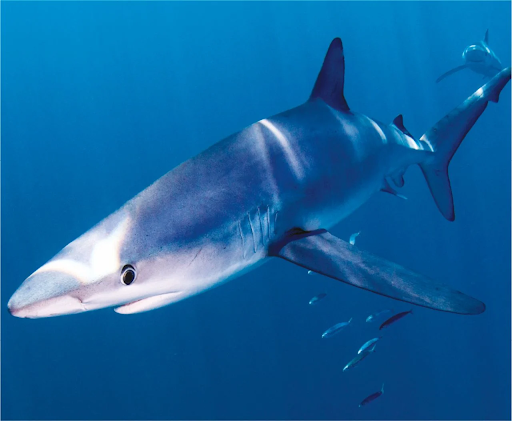
Blue shark. You can see the contrast in colour between the top of its body and underside here.
Photo credits: Tom Burns
So, the UK is definitely not short of its impressive shark species, and here in Falmouth is no exception. We are surrounded by opportunity to encounter some incredible species right on our doorstep - You may have already passed by one of our resident sharks swimming at Castle or Gylly beach without even realising it!
One of the most commonly encountered species in Falmouth's waters is the small spotted catshark. At just 85 cm average length, this is one of the UK's smaller species, and can be commonly found cruising through shallow waters, or resting on the seabed (this trait is called “benthic”, meaning they are found on the sea floor). When threatened, these sharks will curl up into a doughnut shape, earning them the nickname “shysharks”. I think they're pretty charismatic, and I would argue very cute!!

A small spotted catshark
Photo credit: Andy Murch
Also frequently spotted in Falmouth waters is the Nursehound shark, a close relative of the small spotted cat shark. A bit larger than its small spotted cousin at approximately 160cm in length, they occupy similar spaces (shallow shores around the seabed), but have slightly larger and fewer spots and are less abundant.

Nursehound shark
Photo credit: wildlifetrust.org
Both the small spotted catshark and the nursehound are oviporous, meaning they lay eggs from which their pups will hatch. These egg cases can often be found washed up on beaches, and are commonly known as a “mermaids purse”. You can take part in citizen science and help researchers to keep track of species presence and diversity by recording any mermaid purses you find on the Shark Trust App (https://www.sharktrust.org/greateggcasehunt).

A mermaid purse I found on a little cove near Grebe!
I hope by now I have given you a small insight into the incredible diversity of sharks, and why I think they’re so cool. But sharks are not only fascinating creatures, they are essential to ocean health - In fact, a healthy shark population is often used as an indicator of a healthy marine ecosystem.
There are a few ways in which sharks maintain ocean health. Firstly, as largely apex predators, sharks limit grazing fish populations, preventing over-grazing of ocean vegetation such as seagrass. Seagrass is a vital carbon store, capturing atmospheric carbon 35x faster than rainforests, so their protection from overgrazing is key to reducing carbon in the ocean and atmosphere. Sea grass meadows and kelp forests are also essential habitats for a huge variety of marine life, from sea slugs to grey seals, each of which plays a role in balancing the ecosystem.
Secondly, migrating shark species (such as the blue sharks) cause deep sea water that is rich in accumulated nutrients to mix with surface water, supplying essential life-sustaining nutrients to plankton on the surface. Plankton can then absorb carbon via photosynthesis, helping to regulate atmospheric concentrations of carbon dioxide, and form the primary basis of marine food webs.
A third way in which sharks are essential to ocean health, is actually through their poo! Shark fecal matter supplies nitrogen to marine habitats, enabling vegetation to grow and sequester more carbon, as well as directly storing carbon as it sinks to the ocean floor. Furthermore, sharks themselves are made up of 10-15% carbon, so when a shark dies and sinks to the bottom of the ocean, the carbon is not released as it is in land animals, but stored in ocean sediments for potentially thousands of years.
So sharks are really important for keeping our oceans healthy, as well as the atmosphere above water. The problem is, shark populations are declining; about one third of assessed shark species are now threatened with extinction. There are a few main drivers of this decline that are important to understand in order to address them effectively.
First is fishing, or more specifically unsustainable fishing. Sharks are fished around the world for their meat, fins, and liver oil, which contains a compound called squalene (often found in cosmetic products) to the point that entire populations are depleting. Whilst there are some restrictions in place in various regions of the world, they are difficult to enforce and not yet widespread enough to allow vital shark populations to recover.
Sharks are also a common victim of bycatch, where they are caught unintentionally by fisheries with a different target species. Sharks caught in bycatch are often killed or fatally injured.
Sharks take a long time to reach reproductive age, and even then will only produce relatively few offspring, relatively infrequently. This means that population growth is very slow, so when the population is damaged, it takes a long time to recover. For example, basking sharks reach sexual maturity between 12 and 20 years, with a gestation period of about 2 years, so a shark is very limited in how many times it can reproduce in its lifetime. So, when a long-lived species such as this is hunted, it takes many generations for numbers to recover in comparison to short-lived species such as a rabbit, which reach sexual maturity very quickly, have a short gestation period, and reproduce many times in one lifetime, allowing populations to grow very quickly.
Another cause of shark decline is habitat loss. Practices such as bottom trawling and dredging wipes out habitats such as seagrass meadows, kelp forests, and coral reefs that sharks rely on for protection, hunting, and breeding.
Habitat loss as a driver of shark declines is especially prominent in Falmouth right now with the proposed redevelopments of Falmouth docks, which has raised concerns about potential harm to local seagrass meadows and mearl beds. This could devastate the marine ecosystem relying on these habitats, including Falmouth's sharks.
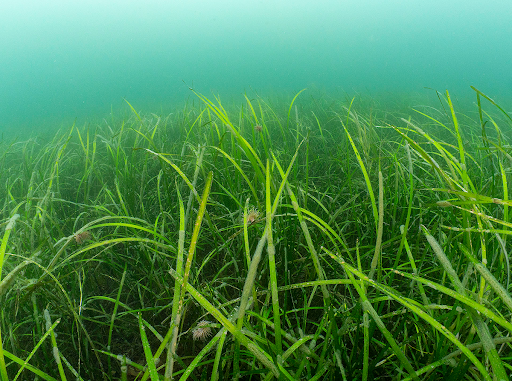
Falmouth’s beautiful seagrass meadows
Photo credit: Paul Naylor
But it isn’t all doom and gloom, and fortunately there are actions that we can take to conserve and restore shark populations around the world, as well as local actions that we can take right here in Falmouth.
Firstly, campaigning for governments to enforce policies to protect and conserve shark populations. Examples of these policies include establishing fishing quotas or banning intentional shark fishing altogether, banning shark finning (a brutal practice in which sharks are caught, have their fins removed, and are then thrown back into the ocean, where they likely will not survive), and restricting infrastructure construction that can damage habitats. Here in the UK, shark finning was banned entirely in 2023, including the import and export of shark fins, thanks to scientists, wildlife advocates and animal welfare organisations.
Establishing marine protected areas is another key strategy to conserve shark populations. These are designated zones where human activities are restricted to allow the marine ecosystem to recover, and have been shown to be highly effective. There are 178 marine protected areas in English waters, which is great progress and shows what is possible when people show that they care. However, this still leaves 49% of inshore and 63% of offshore UK waters unprotected.
A really simple way to help protect sharks is through education. Being informed on the importance of sharks, and the threats they face can help us to make informed decisions when it comes to government policies, the food we eat and the products we buy. There is infinite information on the importance of sharks, their threats and how we can help online, so keep reading and talk to your loved ones about it!
And finally, getting involved in conservation directly is a really important and fun way to help protect sharks. From taking part in citizen science (such as the mermaids' purse records, and projects such as Falmouth Marine Conservations SeaQuest Sundays!) to assisting in underwater surveys, there are so many ways you can get involved in helping to save our sharks.
So if you were in any doubt, I really hope I have convinced you that sharks are not the monsters of the sea, but rather are the key to a healthy ocean and a healthy planet. (I’m still working on my mum, she still reminds me to look out for Jaws every time I get into the water…). I hope I have perhaps shown you that restoring and protecting shark populations is not only important for marine health, but also for the atmosphere on Earth as a whole. If we all try to play our part, we can make a difference for our sharks, and they in turn can make a difference to the future of our planet.
Sources:


Comments